

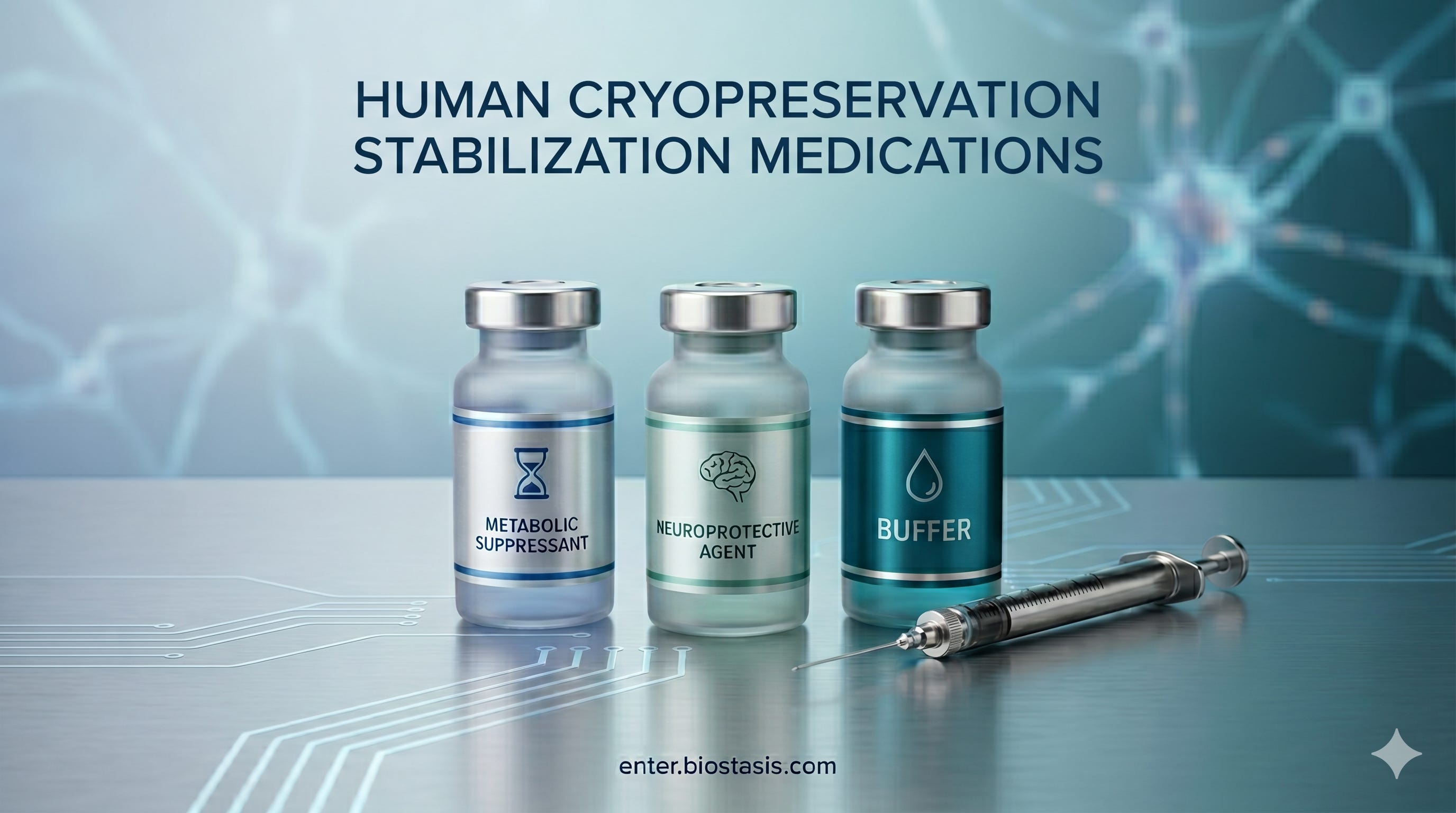
The goal of human cryopreservation standby and stabilization procedures is to preserve the structure and viability of the brain after medico-legal pronouncement of death. To achieve this goal we employ three different techniques: cardiopulmonary support (CPS), rapid induction of cooling (hypothermia), and pharmacological intervention.
The primary purpose of the medication protocol is to reduce or eliminate injury from cerebral ischemia. Ischemia is interruption of the delivery of adequate amounts of both oxygen and nutrients to the brain. The better we protect the brain from ischemic injury, the better the patient’s chances of future revival. This introduction will familiarize the reader with the different classes of medications we use, and some of the issues associated with administering them.
While these stabilization medications protocols have traditionally been formulated for the use of cryonics, it cannot be emphasized enough that any non-elective (out-of-hospital) biostasis procedure that entails a delay between circulatory arrest and start of procedures (such as “chemopreservation”) can benefit from pharmaceutical stabilization.
The effects of ischemia and interrupted blood flow affect both cryoprotectant and chemical fixative perfusion.
Although virtually all the medications ultimately are given to help mitigate the effects of circulatory arrest, many of them are pharmaceuticals with other uses in mainstream medicine. Therefore, EMT’s, paramedics and nurses may be familiar with many of them. The most important differences are the number used, the different context and rationale of use, and (sometimes) different dosages.
Anesthetics
Although the human brain accounts for only 2% of total body mass it accounts for about 20-25% of total oxygen consumption. Therefore, the first priority is to reduce cerebral oxygen consumption to make the brain more tolerant to the limited blood flow (mechenical) chest compressions produce. This can be achieved by inducing deep anesthesia. Because we prefer to use medications that are not scheduled drugs and which also confer anti-ischemic benefits, the current anesthetic of choice is propofol. Naturally, this medication should be given just before, or immediately after, starting CPS. The choice of propofol is a typical example of the sort of trade off that sometimes needs to be made in human cryopreservation. Propofol produces transient hypotension which is undesirable in the context of trying to restore optimal cerebral blood flow. This effect can be mitigated by the administration of vasopressive medications like phenylephrine (see below).
Antithrombotics
The formation of blood clots during after circulatory arrest cases is problematic for a variety of reasons. It may frustrate our attempt to provide adequate CPS, cause incomplete or sub-optimal blood washout, and complicate perfusion of the cryoprotectant solution. For this reason, heparin has been a core stabilization medication since the start of doing standby, stabilization, and transport (SST).
Recent experimental research within the research community (most notably at Advanced Neural Biosciences) has identified sodium citrate as the most potent anti-coagulant - with additional anti-ischemic benefits due to its chelating of calcium (a driver of ischemic injury).
Because anticoagulant agents like heparin and sodium citrate only prevent blood clotting, after termination of mechanical CPS, a fibrinolytic, streptokinase, is added to the washout solution to dissolve existing blood clots.
Vasopressors
In human cryopreservation vasopressors are used to increase blood pressure and selectively shift blood flow to the vital organs (including the brain). The current vasopressors of choice are vasopressin and phenylephrine. Because avoiding some of the side effects of these medications is not as high a priority in human cryopreservation as in conventional medicine, protocol and dosages may differ somewhat from current practice in cardiopulmonary resuscitation. It is hard to overestimate the importance of restoring adequate cerebral blood flow in the human cryopreservation patient.
Because they are rapidly metabolized, vasopressors needs to be given intermittently at short intervals, or continuously infused, instead of administering just one single bolus. Ideally, the quality of chest compressions and oxygenation of the brain are measured to validate stabilization procedures in general, and to make informed decisions about the use of vasoactive medications, in particular. One way to do this is to measure expired end tidal-CO2 (ETCO2).
Cerebroprotective Agents
In the ideal case, circulation and ventilation are restored immediately after pronouncement of medico-legal death, in conjunction with the administration of medications and induction of (surface) cooling. Although this protocol is fairly aggressive compared to that which is usually employed by paramedics in out-of-the-hospital resuscitation from cardiac arrest, it is usually inadequate to completely meet the metabolic demands of the patient. This is especially true if the patient has already experienced some ischemic injury prior to pronouncement and/or the standby team is not able to start the stabilization protocol immediately, or if the patient is febrile at the time of pronouncement.
No (or inadequate) blood flow fails to provide (enough) energy to maintain ion gradients across cell membranes, leading to depolarization. The depolarization of presynaptic membranes overactivates the neurotransmitter glutamate, causing increased calcium ion (Ca++) influx. In the absence of adequate energy production, excessive Ca++ leads to a cascade of damaging events including pathological activation of various enzymes, inflammatory mediators, generation of harmful free radicals and apoptosis (programmed cell death), producing a harmful positive feedback-loop in which one event amplifies and accelerates others.
The agents that are used in human cryopreservation to mitigate ischemia, reperfusion injury, and compromised (micro)circulation in the brain include a variety of medications and chemicals to target different parts of the damaging cascade.
Ischemia-reperfusion induced free radical generation is mitigated by a licensed antioxidant cocktail called Vital-Oxy. Vital-Oxy contains antioxidants like D-alpha tocopherol (Vitamin E), melatonin and the free radical spin trapping agent alpha Phenyl t-Butyl Nitrone (PBN). Vital-Oxy also includes the anti-inflammatory drug carprofen. In a preferred formulation, the (viscous) Vital-Oxy is diluted with magnesium sulfate solution to further enhance its neuroprotective properties.
In abbreviated versions of the protocol the low molecular weight superoxide scavenger 4-Hydroxy-Tempo (TEMPOL) is administered. The antibiotic minocycline also has neuroprotective properties (see below).
This multi-modal approach in treating cerebral ischemia has been developed and proven to be effective in recovering dogs after 17 minutes of normothermic cardiac arrest at Critical Care Research, a California-based resuscitation research company.
Buffers
Human blood normally has a pH of 7.4, which is kept in a very tight range in a healthy human being. But after a (prolonged) period of ischemia, and/or inadequate circulation and ventilation, the typical patient becomes acidotic. This is a serious concern because this condition damages cells, releases destructive enzymes, accelerates blood clotting, and induces clumping of red blood cells (agglutination). Acidosis can also reduce the effectiveness of heparin or some vasopressors like phenylephrine because the drug is effective only within a certain pH range, or acidosis degrades the drug and inactivates it.
To prevent and treat acidosis a buffer is given. The current buffer of choice in human cryopreservation is tromethamine (THAM) because it does not have some of the side effects (like cell swelling) of sodium bicarbonate. In the ideal human cryopreservation case, pH is meticulously monitored and additional buffer is administered if acidosis is observed.
Volume Expanders and Oncotic Agents
Intravenous access is not only necessary to administer medications but also to administer fluids to address electrolyte imbalances and replace volume (in the dehydrated patient). Hydroxyethyl starch (given as Hetastarch) is currently the volume expander of choice in cryonics to address reduced blood volume (hypovolemia), which often occurs as a result of dehydration during the dying phase.
Another medication employed in fluid resuscitation is mannitol. Mannitol has been proven effective in ischemia induced cerebral edema by promoting movement of fluid from the cells to the vascular space. Other advantages of mannitol are reduction of blood viscosity (improving perfusion) and its free radical scavenging properties. Some cryonics organizations use the glycerol polymer decaglycerol (also used as the Z-1000 ice blocker in the M22 vitrification solution). Decaglycerol is used to osmotically inhibit cerebral edema and often co-administered with THAM as one solution.
Both of these fluids are given in fairly large volumes (compared to most of the medications), so a basic understanding of fluid balance and electrolytes is desirable to make informed decisions for the patient.
Antibiotics
Microbial overgrowth can be an issue during long (normothermic) transport times. Minocycline is a broad spectrum bacteriostatic antibiotic that also doubles as a neuroprotectant. Minocycline is free radical scavenging molecule with desirable tissue- and brain penetration and a variety of neuroprotective properties including inhibition of metalloproteinases, inducible nitric oxide (iNOS), PARP, mitochondrial cytochrome c release and, apoptosis.
Administration of antibiotics and the use of sterile technique have sometimes been perceived as redundant and expensive for treating cryonics patients. One answer to this objection is that the guiding philosophy of stabilization is to provide a level of care and commitment at least equal to, or better than, the care the patient received before pronouncement of legal death. It’s also important to note that antibiotics and sterile technique are not only used to treat the patient, but also to protect the stabilization team members from infection.
Antacids
Antacids are used to neutralize the pH of stomach contents to prevent erosion of the stomach wall by hydrochloric acid at low temperatures - an observation that goes back to the small animal hypothermic revival experiments by cryobiologist Audrey U. Smith and colleagues. Erosion of the stomach wall can lead to contamination of the circulatory system with stomach contents and abdominal swelling during later perfusion.
A solution of aluminum hydroxide and magnesium hydroxide (previously sold as Maalox) has traditionally been used for this purpose. Unlike the other medications, antacids are directly delivered to the stomach through a gastric tube or the gastric channel of the i-Gel airway.
General Issues
The fairly large number and volume of the medications raise the obvious question of what the preferred sequence should be. The most important consideration is that the sequence should reflect medical priorities. For example, propofol is administered as the first medication to prevent (hypothetical) CPS-induced return of consciousness and reduce cerebral metabolic demand. Ideally, the administration of propofol is quickly followed by a vasoactive medication to mitigate profofol-induced hypotension. The other high-priority medication is sodium citrate to aggressively mitigate blood clotting and protect the brain against the harmful effects of calcium overload.
The second consideration is to give the small volume medications first, and the larger volume medications later, so that most of the medications can be given in the shortest period of time. Naturally, there can be a conflict between the two. When not desirable to delay the administration of a drug, a small portion of the total volume can be given rapidly and the rest can be administered (as a drip) later. Ideally, several lines are used so there is no conflict between small and large volume administration.
Although the medications currently used in human cryopreservation reflect years of research, review, and experience, it needs to be stressed that this does not completely release the biostasis technician from using medical common sense. For example, a normally hydrated infant may have different fluid (and medical) needs than a severely dehydrated large adult. A patient may have already been heavily pre-medicated with some of the medications in our protocol (heparin for example). If prompt cardiopulmonary support is not possible (for example after one hour of circulatory arrest), it may be questionable and wasteful to administer many medications to mitigate early-stage ischemic injury.
These kinds of issues stress the importance of comprehensive data collection, detailed reporting, and systematic analysis. The more we learn about the different effects of our protocol in different situations, the better we may be able to refine it to suit a particular patient’s needs. In this respect human cryopreservation is not unlike conventional medicine; one size doesn’t fit all.
This is a revised and updated version of an earlier exposition of cryonics stabilization medications from spring, 2006. An extensive review of cryonics stabilization medications can be found here.
Aschwin has provided us with a seemingly comprehensive set of the medications used in optimizing cryopreservation protocols in this article. I found this interesting and feel I have a better idea of why these medications are administered to the cryonics patient. It is also clear that to have the patient in a hospital environment would be helpful, so we all need to work toward mainstreaming cryonics so all protocols can be done in optimal environments.